Transfers, distances and how you actually move
Namibia is enormous and beautifully empty. Here is exactly how we move a small group across it — the airport pickups, the gravel hours, and the flights that save a whole day.
Most of the questions we get before a departure are logistical. Where do I land? Who meets me? How long is the drive? How much of it is on gravel? Nobody wants to spend their first morning in Africa guessing. So here is the whole picture, written the way we would explain it over coffee.
Arrivals
Almost everyone flies into Hosea Kutako International (WDH), forty-five minutes east of Windhoek. A ROAMAFRICA guide meets you inside the arrivals hall with a name board — no shuttle desks, no taxi negotiation. If your flight lands late, we simply move the first night to a quiet guest house in town and start fresh in the morning.
We ask everyone to arrive a day before the expedition begins. It is the single best insurance policy against a delayed connection out of Frankfurt, Doha or Johannesburg, and it gives you a full night of sleep before the first long day.
By land
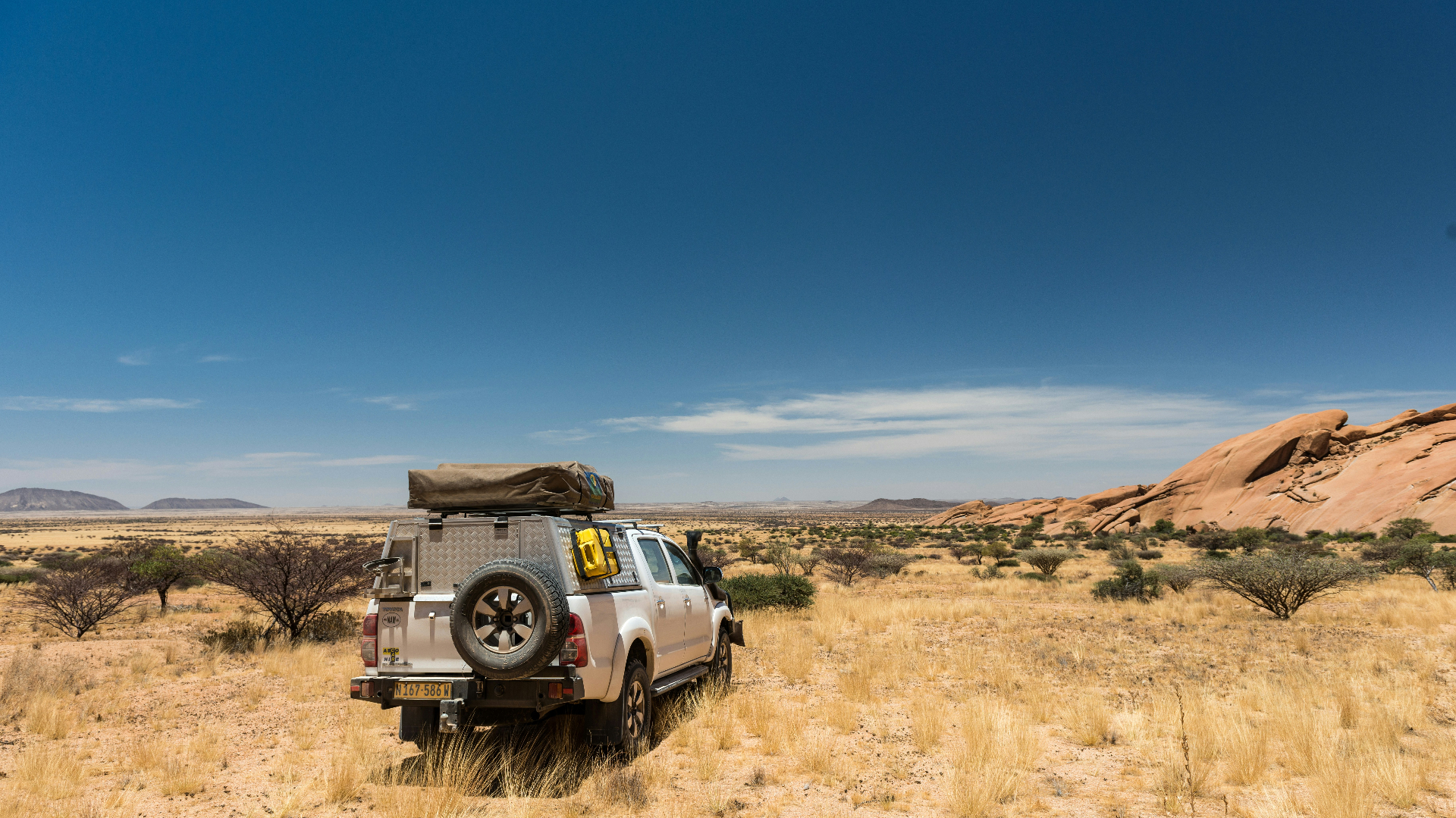
The bulk of the journey happens in a Toyota Land Cruiser on Namibia's gravel network — the C and D roads that make up most of the country. They are well graded, wide, and mostly empty. Our guides drive them at a sensible 80km/h, not because we are cautious for its own sake, but because gravel punishes speed and because the whole point is to see the place.
- Windhoek to Sossusvlei — around 5 hours, with a stop at the Tropic of Capricorn and lunch on the pass.
- Sossusvlei to Swakopmund — around 5 hours through the Kuiseb canyon and the moonscape.
- Swakopmund to Damaraland — around 5 hours, the emptiest stretch of the trip.
- Damaraland to Etosha — around 4 hours, arriving in time for an afternoon at a waterhole.
No driving day exceeds roughly five hours, and every one of them is broken by stops we actually want to make. Two consecutive long drives never happen back to back.
By air
Some distances are not worth driving. The hop from northern Namibia across to the Okavango Delta is one of them: eleven hours of road versus ninety minutes in a light aircraft that flies low enough to see elephant herds moving below you. We use scheduled and charter light aircraft for those legs, and the flight becomes one of the highlights rather than a transfer.
Two hours in a small plane over the Delta will teach you more about the shape of this landscape than two days on the ground.
Light aircraft have a strict luggage limit: 20kg per person in a soft-sided bag, no hard cases. We send a packing note well before departure and store anything oversized in Windhoek until you return.
Borders and paperwork
If your itinerary crosses into Botswana, we handle the border formalities with you — vehicle papers, cross-border permits and the veterinary control points that come with moving between the two countries. It is straightforward, but it goes faster when someone has done it fifty times before.
Most nationalities enter Namibia and Botswana visa-free for tourism. We confirm the current requirements for your passport in writing once you book, and again a month before you fly.
Departures
The last morning ends where it started, at Hosea Kutako, with enough buffer that nobody is watching a clock. If your onward flight is in the evening, we fill the day rather than dropping you at the terminal at nine in the morning.